
Frostrail Survive the frost
Heat, salvage, repair, and the walk home — the run underneath the gunplay.
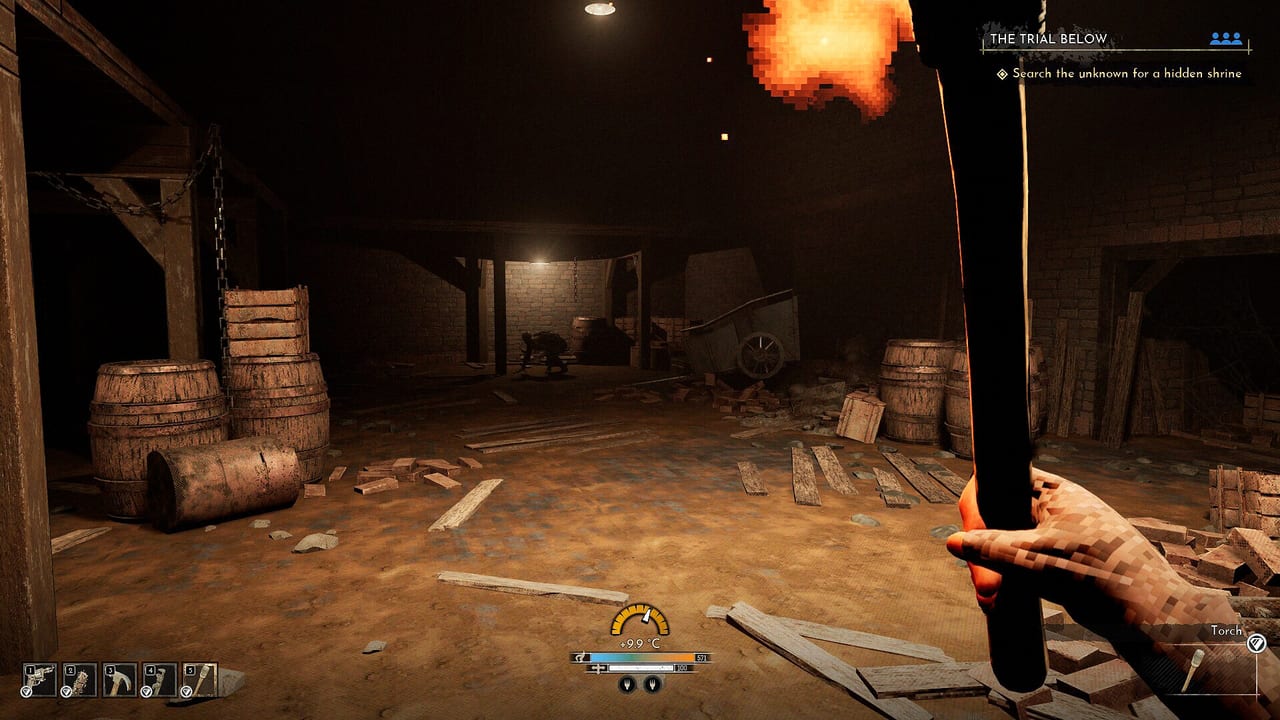
Every trailer sells the gun. Every failed playtest session sells the thermometer. Frostrail’s store copy is not being poetic when it says the frost creeps into your bones and the blizzard blinds, slows, and suffocates. This page is the non-combat run: heat, clothes, scavenging discipline, repair, food, and the decision to leave a shrine underground while it still has loot.
The loop this page plugs into is How to Play. The machine that makes heat possible is the Eden Engine. Tick-boxes for a live session live on the survival checklist.
Heat is the real magazine
HUD captures from tests show a Celsius widget that can read −28 °C on a cab window, +51 °C beside the boiler, and +99 °C in a torch-lit cellar. Those numbers are not flavor. They tell you three biomes of temperature:
- Train interior — you should be able to craft, repair, and reset here. If you cannot, the engine is the emergency, not the next village.
- Blizzard exterior — a timer. Clothing stretches it. Sprinting through deep snow does not delete it.
- Indoor ruins — warmer, darker, louder. A shrine that reads +99 °C is still a fight; it is just a fight where the frost is not the first thing that kills you.
Official language: ration heat, because every step away from the train is a gamble. Play that literally. Time-box stops. If the scout’s widget is falling and the cellar is “almost done,” you are already late.
Clothing is survival gear
2026 development notes added multiple new clothing sets. They sit next to enemy variants and repair workstations in the same patch letter, which is the balance statement. Clothes are how you buy seconds in the white. Seconds are how you buy ammo discipline.
Practical habits:
- Change on the train, not in a doorway.
- Keep a “blizzard layer” and a “dungeon layer” if inventory allows. A heavy coat that is perfect in −28 °C may be the wrong tool in a tight bunker fight.
- Repair clothes on the dedicated workstations. FakeFish reworked repair so maintenance is a place, not a magic backpack button. Broken coats are how “short loots” become corpses.
Scavenge like a quartermaster
The world pitch is stable across a year of news posts: mining camps, villages, wreckage, derelict bunkers, underground vaults. You are not there to empty the art. You are there for fuel, repair materials, ammo, food, Relics, and clothes.
Value order that rarely lies:
- What the Eden Engine burns.
- What the repair bench eats.
- What your actual gun eats — see weapons.
- Relics you can activate on the train this pilgrimage, not in a storage dream — Relics.
- Food and medical if the build uses them as more than flavor. Even if they are light systems, they are lighter than a wipe.
Leave heavy junk. Extra carriages exist so you can grow storage after you prove you fill it, not so you can haul every barrel in “THE TRIAL BELOW.”
Dungeons are optional until they are not
2026 added modular dungeon art, lighting passes, Relics, and levels with multiple exits. That last part is a mercy. A hidden shrine objective on the HUD is an invitation, not a court order.
Turn-back triggers you should agree on before the hatch:
- Half of the crew’s ammo is gone.
- Temperature widget is in the “we will not make the walk” zone.
- Engine player pings a defense encounter or a cold boiler.
- You already have a Relic and the next room is curiosity.
Torch plus pistol is a loadout. Torch plus empty pockets is a documentary. Enemy mix in tight rooms — melee Revenants versus ranged corrupted soldiers — is covered on enemies. Survival’s job is to remind you that the shrine will still be there in a patch; your save is not.
Repair, food, and the quiet minutes
The quiet minutes on the train are the skill expression people skip because they are not cinematic.
- Repair benches — queue them. In co-op the salvage player should not also be the only person who knows where the hammer lives. Controls is where tool swapping lives; this page is where you admit you forgot to swap.
- Food — if a build lets you cook or ration, do it while the engine warms, not while the blizzard is already in the car.
- Sorting — fuel crate, repair crate, ammo crate, Relic shelf. A pile is not logistics.
The walk home is the exam
Exfil through snow is where FPS instincts lie to you. You want to sprint. The blizzard wants to slow you. Engine noise wants to invite company. Rear guard wants a lane. If anyone “catches up later,” they are writing a death recap.
Walk as a group. Spend the first thirty seconds back on heat, not on screenshots. Then spend salvage. Then talk about the next exit. That order is the difference between a pilgrimage and a campfire story about how you almost had a Relic.
What will change after Q4 2026
Early Access is planned to add biomes, locations, dungeons, loot, and train systems for about a year. Clothing, repair, and heat will be tuned. This page will follow updates and the roadmap. Until numbers are official, believe the thermometer more than a content creator’s “never wear X” thumbnail.
If you want a page you can keep on a second monitor, use the checklist. If you want the gun argument, leave this page and go to the tier list. Survival is the unglamorous half that lets those arguments happen twice.
Frequently Asked Questions
Quick answers to the most common questions.
How does cold work in Frostrail?
Heat is a core survival resource. The HUD shows temperature; the blizzard drains you away from the train. Ration outings and use clothing. Exact formulas will move during Early Access.
Where do I repair items?
On dedicated repair workstations added in 2026. Do not wait for a random drop to replace a broken tool.
Should I always finish a dungeon?
No. Multiple exits exist. Leave when ammo, heat, or the train is the scarce resource. Relics only matter if you live to activate them aboard.
What should I loot first?
Fuel and repair materials, then ammo, then Relics and clothes. A full art set in a dead crew’s bags is not progress.